A Bright and Colourful History
Scrolling through Instagram the other day I saw what I thought was carved glass jewellery. It turns out it was resin, but it got me thinking and wondering about glass jewellery.
Trading Beads and Childhood Memories
When we were children we used to swap sweets for beads in northern Kenya, and only now do I realise that what we were getting were probably ancient trading beads. I wish I had been a more knowledgeable — or at least sensible — child and had treasured mine, because glass beads have been used for trading for centuries and are quite precious now.
It stands to reason that these beads originated in Venice, the centre of glass making for centuries. In three prehistoric Eskimo sites in Alaska, Venetian glass trading beads were found by archaeologists, and the theory is that they were traded across Europe from Venice, then to Eurasia and then over the Bering Strait into North America. Carbon dating of other items at the site has put these beads to pre-Christopher Columbus — about 1440 to 1480. Before that, glass beads arrived in sub-Saharan Africa from India and the Middle East as far back as 200–300 AD.
The Romans loved glass beads, and we are lucky enough to have been able to get some Roman glass beads and make them up into the most wonderful necklace. Then starting in about the 17th century, beads were made in their thousands and were used as ballast in trading and slaving ships, which spread them much further afield.
African Trade Beads and Bohemian Glass
In the 19th century the beads brought to Africa by traders were mostly from Venice, but then bead production sprang up in what was Bohemia (now the Czech Republic). Two hundred years later, the beads used in the elaborate and plentiful tribal African jewellery are apparently still made with beads from the Czech Republic. Ghana is famous for its Aggrey beads, which are produced in huge numbers in that country now, but it is thought that the beads originally arrived in Ghana on Phoenician ships trading up and down the west coast of Africa.
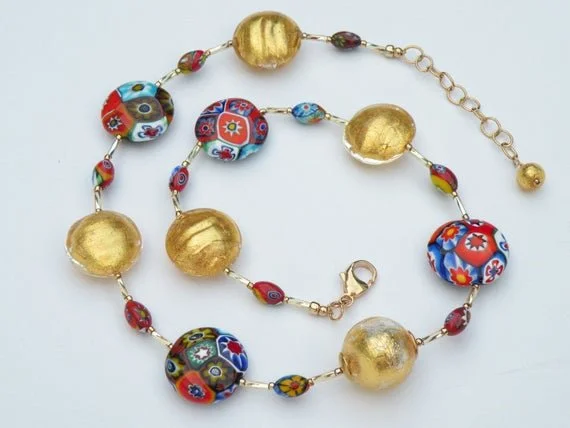
Venice — well, Murano, one of the Venetian islands — still produces glass beads of the most extraordinary quality for jewellery, as does the Czech Republic. But production in both these countries has suffered badly from the inevitable mass production of glass beads happening in China and India.
Dichroic Glass
Not all glass is made up just of silica. Dichroic glass, which is used a lot in jewellery now, is made by layering glass with micro-layers of metals or oxides to create extraordinary colours and shifting patterns. It is bright and beautiful and becoming more and more popular. The jeweller who immediately springs to mind is Charmian Harris, who uses dichroic glass in her work to great effect.
Sea Glass — Perfect Recycling
Not all glass jewellery is made from especially manufactured glass. Sea glass is a really wonderful form of glass for jewellery, and is the direct result of our terrible penchant for throwing things into the sea — like glass bottles. But in this instance it has a great result. The glass gets ground down and smoothed by the action of the waves rubbing it over and over the sand, and sea glass can be found on probably any beach in the world. It does not take much to find it, pick it up, take it back to the workshop and make something lovely from it. Perfect recycling, in fact, even if in minute quantities!
So even as a little magpie I obviously had an eye for a brightly coloured bead — but now that I know a bit more about it, if I ever make a trade again I will hold on to it a bit more tightly this time.