While I was bathing in Vitamin D among my pots full of every colour of pink geranium, I got to thinking about pink gems and wondering what else there is out there, apart from tourmaline, which we use all the time. We don’t use a lot of pink stones so I thought I’d try and figure out why not. It turns out there are numerous pink stones, in fact too many to list and talk about, so I decided to do a sort of Antiques Roadshow segment – Basic, Better and Best – and try to shed some light on the world of pink gems.
Diamonds, obviously, come at the top of the list, but as we very seldom use diamonds I’m not going to go there.
Rose Quartz - Basic
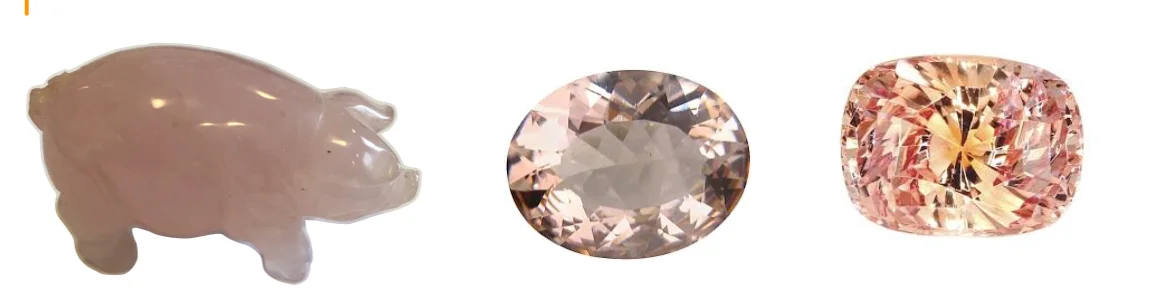
The stone that lands in the ‘basic’ position of the three is Rose quartz. This stone is abundant, common and found in numerous locations, but for all that it’s still an interesting stone. I always think of rose quartz as being opaque and associate it with rows of inexpensive beads, or baskets of tumbled stones, but there’s a bit more to it than that. I wasn’t aware that rose quartz comes in quite a wide spectrum of pink, from almost white with a pink blush to a really strong pink. Generally it’s opaque because it’s full of microscopic mineral inclusions, but just occasionally a transparent piece of the stone is found and cut to gem standards and it is quite beautiful. Sadly the colour in these stones is likely to be unstable and it will fade with over exposure to sunlight or heat. But what I didn’t know is that if a good piece of rose quartz is made into a cabochon with its base cut perpendicular to the quartz crystals, then a most impressive six ray star will often be displayed. A far cry from the ubiquitous strands of cheap-as-chips beads! But being inexpensive also gives this pretty stone another advantage; it’s widely used in lapidary because it’s easy to get and affordable, and is commonly used for small sculptures – like this little pig in the banner image which belonged to Mum. (It sits on my desk and may well be subliminally responsible for this article actually!)
Morganite - Better
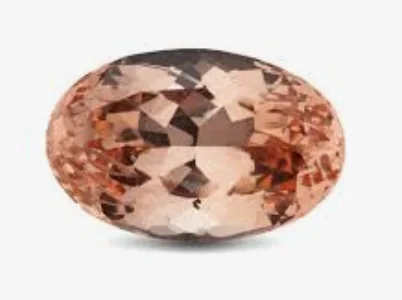
The second pink stone I’ve picked for the ‘better’ position, is something I’ve never even heard of – Morganite. Discovered in Madagascar in 1910 and named for an extremely wealthy financier and avid gem collector, J.P. Morgan, Morganite is actually a first cousin to emerald and aquamarine (which would explain why it’s sometimes called pink aquamarine…)in that they are all beryl. Its colour range is generally very pale; pink-ish, peach-ish, orange-ish and sometimes, in the really large crystals, pale mauve. Unlike most other gems, Morganite can be found in enormous blocks which obviously show a much stronger colour than when cut into small pieces for jewellery gems. It may have been found first in Madagascar but by far the finest Morganite comes from Brazil, and the most amazing thing about this little known stone is that it’s now the third most chosen stone for the centre stone in engagement rings (the first two being moissanite which looks like a diamond but isn’t, and the second being sapphire). I keep discovering how little I know about so much!
Sapphire - Best
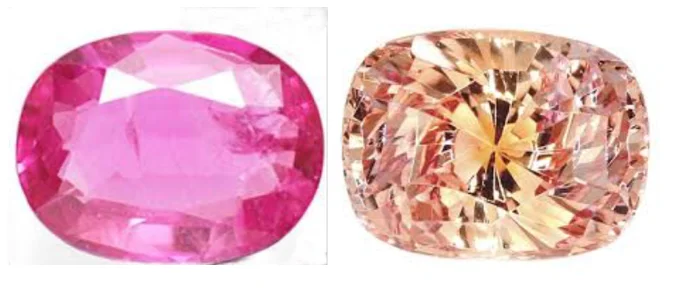
And in best position, a stone with which we’re all familiar but one about which I know very little, I now discover. I did not know, for example, that when a pink sapphire crosses the colour line between dark pink and red, it becomes a ruby! Both ruby and sapphire are corundum, and of course it’s the chemical composition of the stone that decides the colour, so the higher the content of chromium, the redder the stone, and it then becomes a ruby rather than a sapphire. These ‘red sapphires’ are very rare which is why rubies are so precious.
At the other end of the colour spectrum are the pale pink, almost peachy coloured sapphires, the most famous of which is the Padparadscha sapphire from Sri Lanka. Padparadscha means ‘lotus blossom’ in sanscrit and so now we know the colour of a lotus blossom! It is neither pink nor orange but the most wonderfully subtle colour in between. Pink sapphires used to be very rare and sought after and then in the 1990s they were found in Madagascar; this has made them more available, but as with all gems, very high quality pink sapphires are rare and valuable. Inevitably the Padparadscha sapphire has now shot to fame – and therefore desirability – by Princess Eugenie choosing it for her engagement ring, but long before she did that it was a highly sought after stone with good reason. It’s beautiful.
After all this research, though, I’m still no wiser about why we don’t really use many pink stones in our work; I expect it’s because, in general, when we do make a piece with a pink stone it takes a long time to sell and gets very little attention, but perhaps this is because we’re not using the right pink stones. All suggestions welcome, actually!
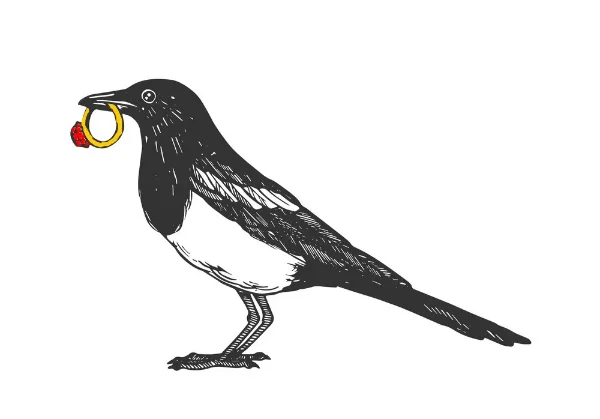
What I do know is that no magpie, anywhere, cares whether their piece of pink comes from the basic, better or best category – they’re all beautiful in their own way and all equally likely to catch the beady eye of a passing magpie.