The Story of Hair Jewellery
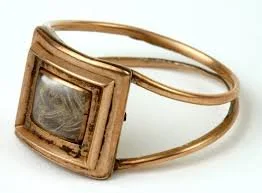
This little brooch — which can also be worn as a pendant — is something I have been familiar with my whole life. It lived in Mum's jewellery box and, though I studied it closely as a young magpie, I never really paid attention to what it is. Then a conversation with Polly reminded me it existed, and out it came from its box to be more closely studied and researched. Is it not astonishing that this tiny, detailed, intricate little picture is made of human hair, all sewn by hand? It seemed such a strange thing to do, and such an archaic idea, that I decided to find out a bit about the why and wherefore of hair jewellery. It is not a long story, but it is an interesting one.
The wording on this little pendant reads: "The farther I fly the faster we tye."
The Victorian Mourning Tradition
Although hair jewellery had been around from the beginning of the 19th century and even before, it was not really in the fashion spotlight until 1840, and then it only lasted for about ten years as the thing to have and the piece to wear. Really, it is the product of the Romantic period of Victorian jewellery and was made and worn as mourning jewellery — the hair of a loved one beautifully plaited or stitched as a piece to be worn in loving memory.
There were a few well-known and trusted experts in the field of hair jewellery who made extraordinary bespoke pieces and set them in precious metal frames — brooches and pendants being the most popular items. But not everyone could afford the services of a professional, so amateur hair artists began springing up, making their own jewellery and then making bespoke pieces set in bog oak frames, which was cheaper and therefore more affordable.
Very quickly it became obvious — apparently — that these fly-by-nights did not always use the customer's own hair but substituted it with animal hair, presumably keeping the customer's hair for the better pieces of non-bespoke work for general sale. As a result, hair jewellery kits came on to the market so that young ladies could make their own at home, at their leisure, using their own hair, or buying it from peasants who would sell their hair for a ribbon or bauble or some other treat for which they could never afford to pay money.
Queen Victoria and the Art of Mourning
It seems a rather maudlin thing to do, I think, but the Victorians were really very good at mourning and everything that went with it. Queen Victoria was a widow for 40 years and wore her widow's weeds for that entire time, and she certainly had a great influence on the Victorian's ability to make the most of mourning. Many also had good reason to mourn with the deaths in the Crimean War and the Indian Mutiny, so rings and pendants and brooches abounded — some made with jet, some with black enamel and gold, some with hair, but all appropriately black and mournful.
But back to the hair jewellery. Interestingly, the Swedes really took to this and have been making hair jewellery for over 200 years, and they still do. The Hairworkers Society was founded in 1994 and the Victorian Hairwork Society is also very active. Who knew!
Another interesting thing I learned is that apparently a life-size portrait of Queen Victoria was made entirely of hair and was one of the exhibits at the International Exposition in Paris in 1855. I have searched everywhere for an image of this extraordinary work of art but have come up empty — so whilst I do not question that it existed, I cannot show it to you because I cannot find it. If any of my avid readers know of this picture and can find an image of it, I would love to see it!
A Modern Revival
Fashions go in cycles, and commemorative jewellery is quite a thing again, it seems. There are several jewellers who specialise in it, using ashes of the deceased — both human and animal — and mixing them in coloured glass and semi-precious stones to good effect, actually. Using hair is also back on the cards, and I have to wonder why I find it less maudlin in a modern context, but I do.
Whilst I find this medium extraordinary and certainly interesting, as a magpie I have to say that I think I would be happier finding a little locket stitched with gold thread rather than hair — but hey, if even just the frame glitters a bit, I would certainly pick it up for a closer look.