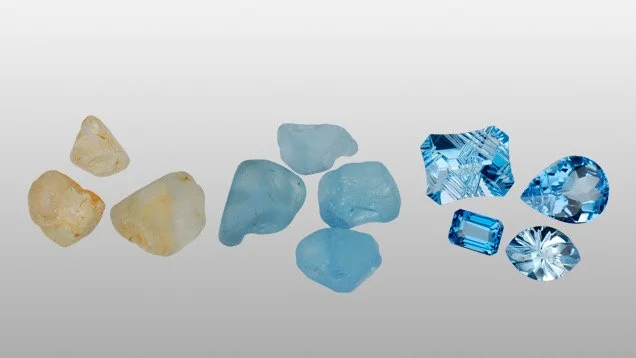
The Beauty Hidden Inside
Being called a diamond in the rough is actually quite a compliment, because it infers that with a bit of work and a good polish, the end result will be a real gem. It is also the truth about stones, of course. I have watched more than one documentary on mining for gems and I am always impressed that the miners can pick up a chunk of dirt — literally — and go bananas about it, because they can see exactly what it is. I always imagined that gems come out of the ground the colour they are when we buy them all cut and polished. Some do — but not all.
Heat Treatment — Transforming Stones
Aquamarine, for example, is quite a milky stone, but with heat treatment to remove the milkiness and the yellow tinge, we end up with the most wonderful clear stone that we all know and love. Tanzanite came as a huge surprise to me because when it comes out of the ground it is an uninspiring brown. (How did the person who dug up the first tanzanite know it would be something wonderful when heated?) With heat treatment we get those wonderful blue and mauve stones that we all want.
Rubies and sapphires have been heat-treated for centuries — perhaps as far back as the Romans — but it really became common practice at the beginning of the 20th century. Apparently rubies have a blue core which disappears permanently when heated, producing the rich, gorgeous pigeon's blood red gem. I also did not know that when amethyst is heat-treated it goes paler rather than darker, and with even more heating it turns into citrine!
Emeralds — Oil, Not Heat
Not all stones are heat-treated. Apparently emeralds are never subjected to heat treatment, but very often they are soaked in cedarwood oil which, at a molecular level, fills any surface-reaching inclusions. The oil is not permanent and might need refreshing — but only after many, many years.
As an aside on the subject of emeralds, Polly was introduced, many years ago now, to an old gentleman in Rome who could read emeralds. He could look at an emerald through his loupe and tell you where it came from, right down to the mine, and how old it was. This is presumably something to do with knowing that the most precious and sought-after emeralds come from three countries — Brazil, Colombia and Zambia — and they are all a slightly different colour because the trace elements responsible for the stone's colour are different in each country. But what a great party trick that would be!
Along with emerald, garnet, peridot, chrome tourmaline and opals are among the stones not typically heat-treated, but of course they are cleaned, cut and polished to reveal their beauty — which is, in its way, another form of treatment.
Counterfeit — or Art?
A Swiss couple really perfected the art of heat-treating sapphires and rubies in particular, and apparently at the end of her life the wife felt a great deal of guilt for making counterfeit stones. But I think her guilt was misplaced. Did the Japanese potter who discovered raku firing then sell counterfeit pottery because it was no longer just plain clay? No, of course not. I think the good lady and her husband are owed a huge debt of thanks for finding a way of producing stones of such astounding beauty out of a lump of rock.
And anyway, a magpie never asks how came this beautiful bauble? It just scoops it up, chattering with glee, and flies it home to add to its collection of other wondrous things. Sensible bird.