Enduring Beauty and Brilliance
Ever since my fledgling magpie days — quite a long time ago now — I have been captivated by enamelling in jewellery, probably subconsciously ignited by a thimble Polly made when she was a student and I was at junior school. The colours, the light, the intricacy — everything. The idea of painting a beautiful picture with glass really caught my imagination, and nothing has changed. I still love it, and one day I am going to learn how to do it, but for now I just have to make do with enjoying the fruits of other people's labours. But that is not nothing.
Enamelling is made by fusing powdered glass to a substrate — copper, silver, iron, glass, ceramic, stone — in fact anything that can withstand the fusing temperature. It is a really ancient form of decoration, and probably the oldest piece ever found was from Cyprus, made in the 13th century BC. It is cloisonné and is remarkably well preserved for its age. It is generally believed that eventually enamelling was used in place of gems that were cut and inlaid, as in those found in the Staffordshire Hoard. It was less costly, easier, and more colours could be included in a single piece.
There are really three types of enamel — cloisonné, champlevé and painted enamel — from which all sorts of variations and progressions have been created.
Cloisonné
Cloisonné (French for partition) is the art of fixing very thin wire walls or barriers to a metal surface, filling the spaces created by these walls with frit — a mixture of silica and flux to make glass — and then firing at very high temperatures. I wondered about how the metal survives these very high heats, because the melting point for glass is extremely high. It seems that the flux is mixed into the silica to reduce the melting point so the glass melts before the metal. So clever.
By the 14th century this technique had reached China, and it was the Chinese who moved on to using it in much larger objects like vases and bowls instead of just for jewellery. The Egyptians had their own version of this technique but used thicker wires; the Byzantines used it too, and it is thought that it was they who influenced the Chinese in this art. By the 19th century, the Japanese — late comers to cloisonné — were producing the most advanced pieces ever known.
As with all things creative, people experiment and come up with new ideas. An advance on cloisonné is plique-à-jour (loosely translating from the French as letting in the day), which is a similar technique where enamel is applied in cells, but in this case the backing of the piece is then removed so that the light comes through the enamel glass, like stained glass.
Champlevé
Champlevé (from the French for raised field) is the technique where the surface of the metal is carved, stamped or otherwise depressed, and the enamel is put into these pits and fired, leaving the surrounding metal exposed so that the enamel sits level with the metal around it. It seems to have originated with the Celtic tribes, and the Romans used it widely in everything from jewellery to armour. Champlevé enamels from Limoges in southern France are the most famous and have been since about the 12th century.
Initially opaque enamels were used because the bottoms of the recesses were rough and did not want to be shown, but progress brought basse-taille — where the bottoms of the recesses were modelled or the surface of the metal decorated with low-relief design. With the use of translucent rather than opaque enamels, the patterned metal could be seen through the glass. The most wonderful example of this is the St Agnes cup, made for the French royal family in the 14th century. Quite extraordinary work.
Painted Enamel
The third sort of enamel work is painted enamel which is, as the name suggests, a picture painted with enamel on metal. Limoges were also masters of this, and it was they who developed grisaille enamelling in the 16th century — a dark layer of enamel laid down on a metal surface, with translucent enamels built up on top to create a monochrome picture.
I think mostly we associate enamel with jewellery, but if you think about what is in your house you will see that it is used industrially a great deal too: bath tubs, washing machines, cookware, laboratory equipment and even on the top of telegraph poles. Certainly this is enamel paint rather than ground glass fired in a kiln, but the effect is the same — glossy, durable and completely protective of the metal underneath.
Masters of the Craft
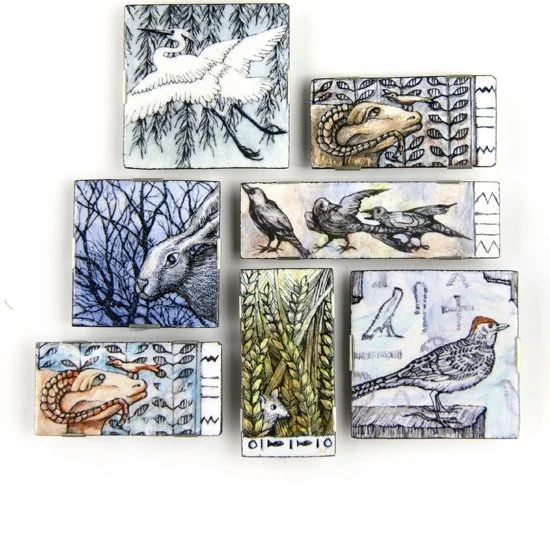
One master enameller here in Kent is Joan MacKarrell, whose work is in homes all round the world. This lucky magpie has one of her brooches! She is among a handful of the most brilliant enamel artists working in this country right now, and because it is quite important to have something to aspire to, I go one better and aspire to two things: the first, as an artist, is to learn how to enamel. The second, as a magpie, is to own a piece of silverware made by one of the brilliant contemporary enamellers with whom we rub shoulders at various shows — Fred Rich.
Dream on, little bird.