A Fascinating Subject
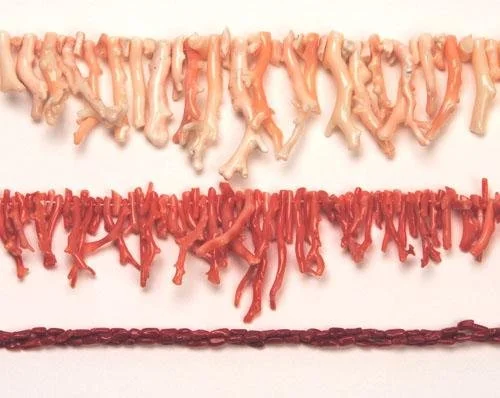
When I was doing my research for Hey, Pinkie! — a blog about pink gems — I came across a pot of coral beads, the palest of which caught my eye, and Polly told me it is called angel skin. How lovely is that! She also suggested that coral would be a good subject for an article, and of course she is right — it is a fascinating subject.
Coral Through the Ages
Coral, like turquoise, is one of the most ancient gems and has been used for millennia, especially corallium rubrum, the well-known red coral. The ancient Egyptians were partial to it, as were the Greeks and Romans. The scientific name for black coral — antipatharia — means against disease, which is really one of the reasons coral was so important in ancient cultures. It was considered to be full of medicinal properties and worn to ward off disease and to protect children in particular from evil. Children from wealthy Roman families often wore coral necklaces from a very early age — lucky little things.
On the other side of the world, the Native Americans used coral in their adornment, and inland cultures far from the sources of coral would obtain it through trade. One of the most active trade routes was between the Mediterranean and India, where coral was believed to be full of medicinal and sacred properties. Apparently the Gauls used coral as decoration in their weapons and helmets, but demand from India was so great that it was rarely seen in the areas that actually produced it. In more modern times it was the Victorians who really loved coral, and some of the pieces of jewellery they produced were astonishing — like a bracelet which belonged to our grandmother. As an aside, they also favoured coral teething ring rattles too — coral was good for everything, it seems!
Torre del Greco — The Coral Capital
But the greatest players in the history of coral are the Italians. Red coral is found mostly in the Mediterranean — around Sardinia, the Straits of Gibraltar and historically off the coast of Naples. A region of Naples called Torre del Greco flourished as the heart of the coral trade. It was fished nearby, processed in Torre del Greco, and the whole trade was run by the Torre del Greco fishermen — the sort of Coral Mafia, if you will. Even today the lifeblood of Torre del Greco is the coral trade. But the corallini, as the natives of Torre del Greco are sometimes called, were not the only ones fighting for rights to their patch of coral. As far back as the Middle Ages, securing the rights to the coral fishing off the African coast was heavily fought over by the Mediterranean countries of Europe.
A Story from Marrakech
On the subject of the source of coral, I have to relate a very funny story. When we were in Marrakech we found ourselves caught in a four-storey retail tourist trap, being guided and persuaded by a man now affectionately known as The Grand Vizier — you know the man: slick hair, pencil-thin moustache, lizard eyes, pointy leather slippers. While he was trying to persuade Polly to buy some completely inappropriate but lovely furniture, I wandered into the jewellery section and asked the very nice young man where the coral had come from, thinking Mediterranean or perhaps Red Sea.
His English was not good enough to understand, so he fetched The Boss. Enter the Grand Vizier. "Where is this coral from?" "That is from the High Atlas mountains." What?! Thinking he might have thought I was pointing to the turquoise, I tried again. "Er, no — where is this coral from?" "Yes, coral — from the High Atlas Mountains." Sneer, rub hands. Well, what can you say when you are faced with that sort of knowledge and those lizardy eyes? He did bring us a glass of wonderful mint tea, though, so it was not all bad!
Hard and Soft Coral
There are two types of coral, hard and soft — which translates broadly into red and black, each with hundreds of subspecies. Red coral, the most popular for making jewellery, has a hard calcareous skeleton and gets its colour from the algae that live on it in a wonderfully symbiotic relationship: it provides food for the coral and the coral gives it somewhere to live. It grows in both shallow bright waters and deeper water in most of the oceans of the world, and its best-loved feature is that it polishes to the most wonderful shine. It also comes in a wide range of colours, from angel skin to ox blood and everything in between. The darker the colour, the more valuable.
Black coral grows deeper and is associated more with Hawaii, China and Indonesia. The skeleton of this coral is soft and flowing and it grows feathery branches a bit like ferns. It is more the growth habit that defines it as black coral than the actual colour, which can range from black to nearly white.
Conservation and Sustainability
It is hard to determine exactly what the status of either of these corals really is. The fishing of coral is mostly very rigidly controlled, but as with everything in demand there are poachers aplenty. Climate change and pollution have also had a devastating effect on the coral beds, of that there is no doubt. Conservation of coral has been in place for many years, and the only permissible way to fish coral today is by scuba diving — no more dragging nets across the ocean floor. For this reason we buy our coral at auctions or in antique shops, which seems to be the most sustainable way of doing it without contributing to coral's already pressured existence.
A little-known factoid: the city of Oxford is partly built on the remains of a coral reef that flourished 155 million years ago, and there is evidence of this coral being used in buildings all over the city — one of the best examples being the Saxon tower of St Michael at the Northgate.
And for this magpie — well, angel skin or ox blood, I just love a bit of coral, me!