Who Knew?
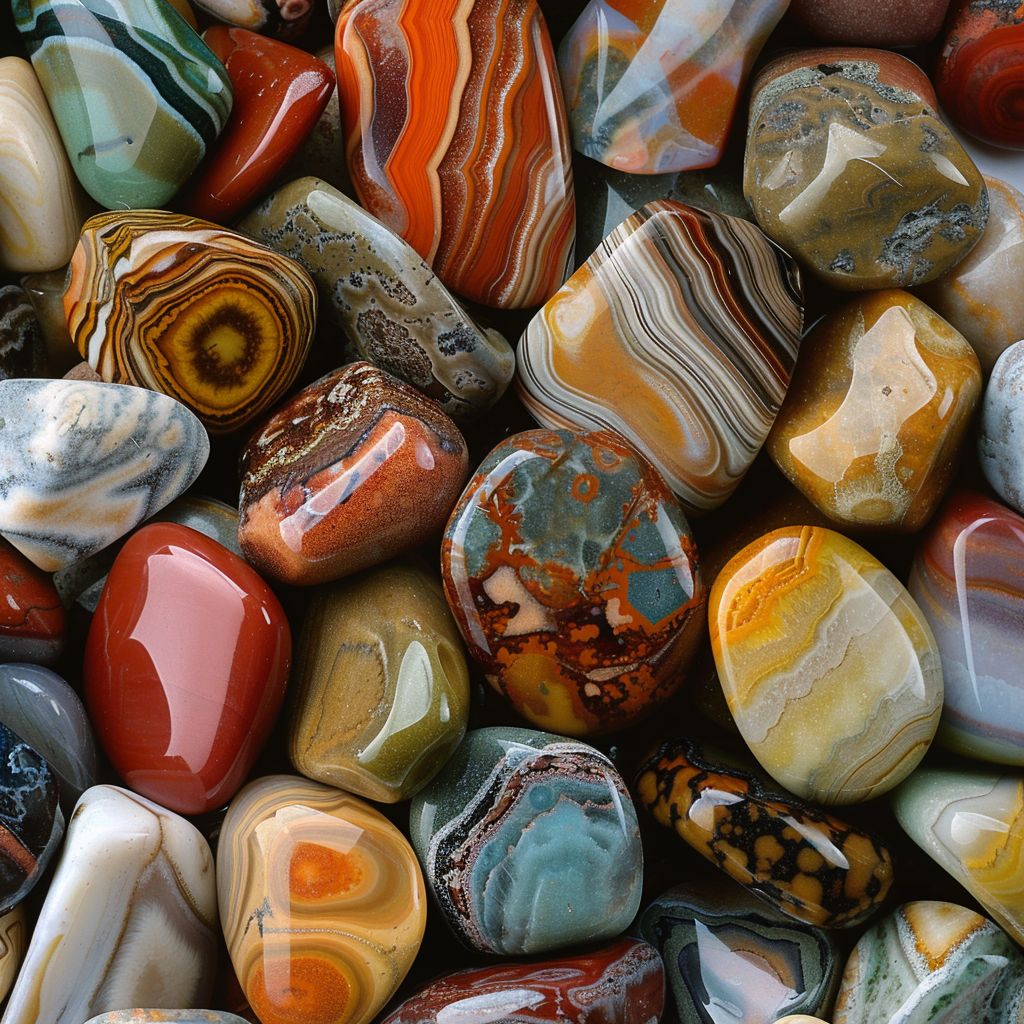
When we started the company in 2007 we used, out of necessity, a lot of stones that Polly had in stock already from long ago, or we bought quite inexpensive stones to start off with until we saw how it all went. Among these were some flat faceted beads of banded agate and, I confess, at the time whilst I did acknowledge that the patterns were astonishing, the colours were very muted and they did not do much for me. I thought that was all there was to agate — nice but nothing special. Shows what I know.
A Commission That Changed Everything
The turning point for me was being given a really wonderful commission for a Roman intaglio ring, the intaglio to be carved in green agate. We easily found the perfect stone for the job but, far from being muted and pale, it is the most incredible dark green and flawless — quite the opposite of the first agate beads we used. It struck me as interesting that the same stone could be so different, so I went on a bit of a dig for knowledge.
Like most gems, agate has been used for thousands of years, not only in adornment but as tools and vessels as well, because it is plentiful, hard and carveable, and takes the most wonderful shine. The oldest pieces of carved agate, dating back to the Bronze Age, were found in Crete — which is where agate was first discovered. It was named after the river on whose banks it was found — the Achates — by the philosopher and naturalist Theophrastus in about the 3rd century BC.
The Holy Grail of Valencia is carved in red agate. It is only the agate cup that is thought to have been carved in the time of Christ; the elaborately decorated stand was added much later. The Romans loved carving agate — hence the very familiar intaglio seal rings — and it makes the best cameos too, because of the layers of colour which are purer and much more long-lasting than cameos carved out of shells. Agate has even been used in buildings: the Agate Rooms in Russia were the dream of Catherine II and the genius of a Scotsman called Charles Cameron, employed by Catherine to create the rooms for her.
A World of Colours and Patterns
Because agate is found all over the world — including Antarctica! — it comes in the most diverse colours and patterns, and it seems that everywhere that produces it calls it by their own name. So there are literally hundreds of different agates. Botswana agate, for example, is really a banded agate, but is distinguishable by its pink hues which have made it famous and worthy of its own name. In truth most agates belong to one or other of several families and are simply found in varying patterns and colours.
Agate is chalcedony and quartz and is mostly formed in volcanic and metamorphic rocks, which means there is plenty of opportunity for the agate to be coloured by different minerals and shaped by different geological events. A simplified version of the groups of agate is: moss agate, banded agate, lace agate, dendritic agate, fire agate and iris — or rainbow — agate, and as they are all so different they all deserve a quick look.
Moss and Banded Agate
Moss agate is so called because oxides of iron and manganese get embedded in the chalcedony and form moss-like inclusions in the rock. There is no actual vegetation involved, in spite of appearances! It is found mainly in North and South America, India and Europe, and is usually formed in volcanic rocks. It looks fabulous in jewellery.
Banded agate — the one with which we are all probably most familiar — is also a volcanic by-product, consisting of microscopic quartz crystals formed from layers of deposited silica in volcanic cavities. Banded agate forms some of the most exotic and colourful patterns, probably because it is found all over the world in different geological situations.
Lace and Dendritic Agate
Lace agate comes in two varieties: blue lace agate, found in Africa (mostly Namibia), which is particularly hard; and crazy lace agate, found in northern Mexico, which comes in stunning patterns — usually red, white and yellow.
Dendritic agate, from the Greek word dendrites meaning tree-like, is along the same lines as moss agate but much more dramatic, sometimes forming whole miniature scenes. For obvious reasons, good pieces of dendritic agate are highly collectible. Like moss agate, dendritic agate is found almost all over the world, but the most notable pieces apparently come from Crete.
Rainbow Agate and Fire Agate
And then we come to the two most extraordinary, surprising agates, about which I knew absolutely nothing — including that they even existed! The first is rainbow — or iris — agate. This is really a banded agate, but in order to see the rainbow it needs to be cut very thinly so that the stone can be lit from behind to enhance the colour. It is not a rare agate, and is used mostly either displayed with a light behind it, or for its metaphysical properties. It is absolutely beautiful.
Last but by no means least is fire agate. This is found only in the south-western United States and in Mexico, and was formed millions of years ago when that part of the world experienced massive volcanic activity. Hot water saturated with silica and iron oxide repeatedly filled bubbles and cracks in the rock, building up layer upon layer and creating vibrant iridescence. This agate is rare and precious — and I really, really want to see one in person!
I have been amazed to discover all this about the humble agate. But what has surprised me most is realising that this dedicated magpie really missed a trick by paying it so little attention all these years. Not any more!