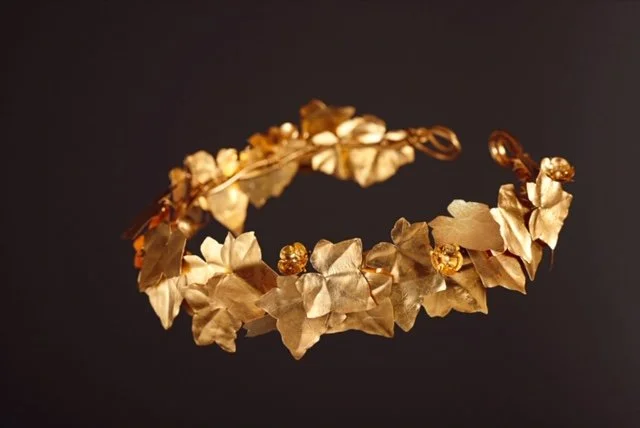
A Dream Commission
In 2012 — the year of the Queen's Diamond Jubilee and the year the Olympics were held in London — Polly was commissioned by the World Gold Council to make a wreath. This was a dream come true because she had always wanted to make one, but as they are not exactly the hottest-selling item in the jewellery world, she had never had a reason to do it. So a labour of love began.
A lot of planning and designing, a lot of trial and error, and many ivy leaves later, the wreath started to take shape. After five months the magnificent finished product made its first appearance, being modelled at Goldsmiths' Hall in the Gold: Power and Allure exhibition sponsored by the World Gold Council. What a beautiful thing it is — still waiting in our safe for someone else to love it and need it. What a happily fulfilled dream for Polly.
Extraordinary Facts About Gold
During the making of this thing of beauty — and a joy forever — we had a great many dealings with the World Gold Council, and out of these came the most extraordinary facts about gold, none of which I knew.
Did you know that gold is the most ductile of all metals? One troy ounce (about 31 grams) can be drawn into a wire more than 100 kilometres long. It is so fine when drawn like this that an Italian artist, Giovanni Corvaja, made hair out of the gold and used it as fur around a hat.
Gold is also so malleable that the same amount — one troy ounce — can be beaten into a sheet 300 feet square. And it is so rare that there are only about 0.005 grams per tonne of the earth's rock. No wonder it costs so much! This probably accounts for the fact that gold is one of the most reused and recycled metals on earth, with recycled metal accounting for over a third of the supply of gold.
Gold in Everyday Life
The wonders of gold — which does not tarnish in air or water, resists chemical action and is not easily attacked by acids — have been known to man for a very long time. The oldest known example of gold work dates back to the Bronze Age, circa 2470 BC, and when it was dug up the gold was as bright as it was when it was buried.
Gold is not only used for jewellery, coins, medals and secular accessories like chalices and fonts, but it plays a huge part in our everyday lives. Because gold is highly conductive to electricity and highly resistant to oxidation and corrosion, it is widely used in industry. Thin layers of gold are used in circuit board contacts where good electrical contact is necessary, and because it is such an excellent reflector of light — including infrared light — it is the perfect material for shielding the sensitive parts of spacecraft, spacesuits and missiles against radiation.
Gold in Food — and Dentistry
Everyone has seen gold dust in glasses of champagne at weddings, and gold leaf on Michelin-starred plates of deliciousness, but I bet you did not know that eating gold is a very ancient idea. It has been used since medieval times as decoration on food and in drinks, and while it is not an essential part of our diet — sadly — it is an inert metal and can be ingested without harm. It is certainly all these properties combined that make gold so useful in dentistry too. And did you know that Sir Winston Churchill had a partial upper denture made of gold, designed to compensate for his lisp?
I could go on reeling off facts about gold until it gets dull — ha! But most important is the happiest fact about gold for a magpie: gold is mined on every continent on earth except Antarctica. But there are no magpies there either — so happy magpies the world over!