From Bones to Bakelite
A very clever little magpie niece of mine in Kenya — also a Polly Gasston! — inspired my next idea for research because she takes full advantage of the wonderful tropical wood at her disposal and makes interesting, wearable and unique jewellery with it. It made me think about what people were using for jewellery before the discovery of and passion for silver and gold.
The Oldest Jewellery Ever Found
Evidently jewellery — or adornment of some sort, anyway — has been worn forever, literally. But what is so interesting is that every country seems to have the oldest piece of jewellery ever found! I think perhaps Spain wins with perforated shells dated to 115,000 years ago, which puts them in the age of the Neanderthal. In South Africa, beads made from snail shells and dated to 75,000 years ago stake their claim as the oldest. A kangaroo bone adornment dating back 46,000 years is Australia's claim, and ostrich egg beads found in Olduvai Gorge in Tanzania are also in the running. But it does not matter who wins, because they all show very clearly that man — Neanderthal, Cro-Magnon or Homo sapiens — all had some sort of jewellery, and that is as old as it gets!
It is impossible to know the reason these ancient people made and wore jewellery, but it is widely believed to have been for all the same reasons it is worn today: adornment, ceremony and status in the main, and in some cultures for protection. Amulets have been worn in cultures for all time and in all parts of the world — made from wood, bone, stone, and even animal teeth, claws and eagle talons. The belief in their powers was strong, from protection against evil and illness to power with fertility and strength. It could be argued that pendants are the descendants of amulets, worn round the neck, each with its own significance.
Metal, Glass and Ancient Traditions
Using metal in jewellery really only started about 7,000 years ago when the first pieces of copper jewellery were made. Even though metal forms the basis of most jewellery now, there are still so many different materials used alongside it. The Egyptians used faience beads extensively (glazed ceramics) with their metal, and they also made glass beads — glass is still a common component in jewellery, not just because it is cheap but because it is colourful, plentiful and readily available.
The Maasai started using glass beads the moment beads arrived in Africa, brought by traders, and before that they used coloured stones and dyed bones in their elaborate, decorative and highly symbolic jewellery. Ostrich egg was also used extensively from South Africa right up to Kenya. In North America the oldest jewellery ever found were four bone earrings aged to about 12,000 years ago, found in Alaska. Another highly decorative and very old form of jewellery from America is quill jewellery, made from porcupine quills.
Interestingly, many of the materials used right from the very beginning are still used today. Gems, after all, are just stones that have been cut, polished and heated to make them what they are, but before they became precious they were just useful! Bones from cattle, deer, goats and camels are still used in jewellery, as is wood, of course. We are all familiar with cowrie shell jewellery, which has been made for millennia and still is — now sometimes enhanced with a little gold or silver. All sorts of shells are used in jewellery now, not just cowries.
It stands to reason that arguably the very best glass jewellery comes from Murano. It actually started being produced in Venice itself in the 13th century, but the fear of fire from the kilns meant the glass makers were moved to their own island — Murano — where they had to stay, keeping their secrets under threat of a prison sentence if they told anyone how to make glass. It is still produced today, and some of the genuine product is absolutely wonderful. (Sadly, unless it is signed Murano, it was probably mass-produced in China.)
Dichroic Glass — Ancient and Modern
Another form of glass used more and more is dichroic glass — two colours — and whilst this is actually a very ancient form of glass seemingly invented by the Romans, it was NASA who made it bright, beautiful and interesting for jewellers. As an aside, do take a moment to look up the Lycurgus cup, made of dichroic glass by the Romans in the 4th century. It is beautiful and astonishing.
The Age of Plastics
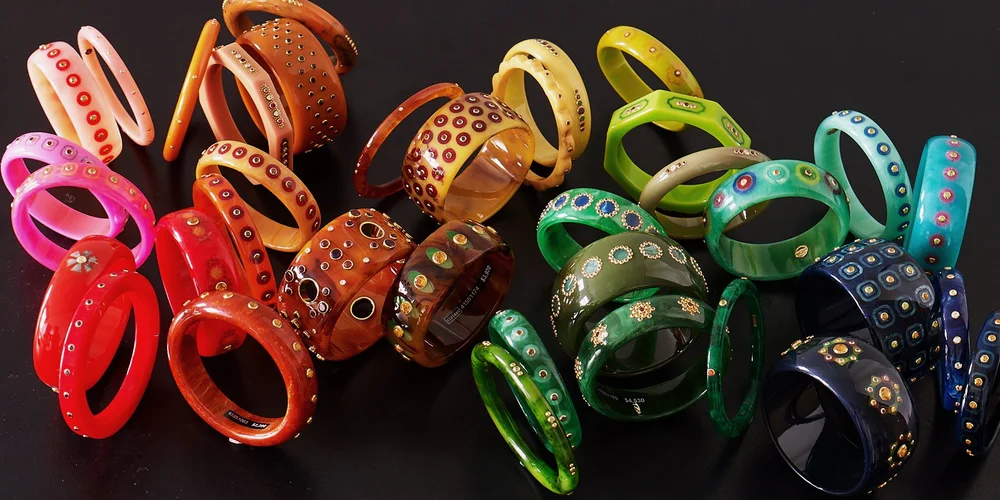
But something the ancients did not have, and which we use extensively in our adornments nowadays, are plastics — bakelite, celluloid and Perspex in particular, and they are a wonderful addition to our resources for adornment.
First came celluloid, invented in 1855 and made of nitrocellulose and camphor. It used to be used for film but now it is used for countless everyday items from musical instruments to jewellery. It takes colour well and is incredibly flexible and shapeable.
Next came bakelite, the first plastic made from synthetic materials, in 1907. I always think of it as a radio case — as seen on television, not because I am that old! Bakelite jewellery was very popular in the 1930s. It carves well, laminates together, holds amazing colours and has become very collectible.
And the third on the list is Perspex (which is actually a trade name for this acrylic product), invented in 1934 and really a shatterproof glass. It is lightweight, easy to cut and takes colour very well. The best examples of Perspex jewellery I have seen are made by Shelby Fitzpatrick. With her background in silversmithing, textiles and ceramics, Shelby obviously has an eye for colour and design, so it is no surprise she makes the most fun and colourful jewellery — so easy to wear (it weighs nothing) — and she has a piece for any outfit, guaranteed!
Reading back over this it strikes me that almost anything, literally, can be turned into jewellery and always has been for as long as man has walked the earth. It makes me think that magpies must be one of the oldest species of bird, then.