Ancient Methods, Ancient Design
Polly's work has been greatly influenced by the ancient jewellers — Mycenaean, Egyptian, Persian and of course Roman and Greek — and I inherited this passion from her. Recently we have been drawn to Roman design quite a lot, in particular intaglio work. The history of intaglio is a whole story in itself, but I just want to touch on it briefly with this little ring.
The Ring from Venice
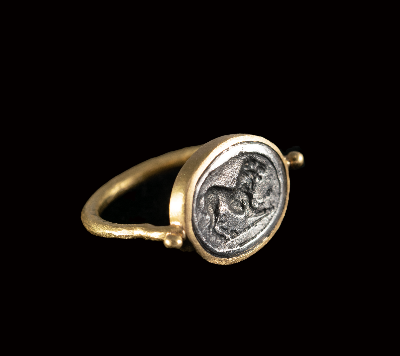
Many years ago Polly bought a ring in Venice depicting the lion of St Mark's. We thought it would be wonderful to be able to make and sell something like this ourselves, and really the only way to do it was to take a casting from it and make our own version. We did not want to replicate the whole ring — we just wanted the intaglio lion — and in our search we were introduced to the art of using cuttlefish bone for taking the impression.
It turns out that cuttlefish bone carving and casting dates back thousands of years to the civilisations we so admire — Phoenicians, Greeks and Romans — so it all fits together perfectly. Cuttlefish bone sounds so unlikely, but it is very soft and powdery and really good for carving, so we thought it would probably take a good impression, and we gave it a go.
The Process
Luckily cuttlefish is not expensive to buy, because it took more than one try to get the perfect impression by pressing the ring straight into the cuttlefish. Press too hard and the sides crumble and the image is distorted; too soft and the impression is not deep enough from which to take a casting. And then suddenly we got it right — just enough pressure and there was a tiny, perfect little lion in the middle of a big piece of cuttlefish.
I do not intend to give you a lesson in casting in cuttlefish, but suffice it to say that it was a nervous time cutting the pouring channel down to our little lion, and even more nerve-wracking pouring the molten silver into the cuttlefish. But what a result! It came out absolutely perfectly. A bit of a clean-up before setting it in the ring, and then a dip in oxidising liquid — rotten eggs, hold your nose! — and voilà!
It is no wonder then that with these ancient — and really rather fun — methods, and the ancient design inspirations all around us, we just love making these treasures. They have always been loved by magpies, too.